
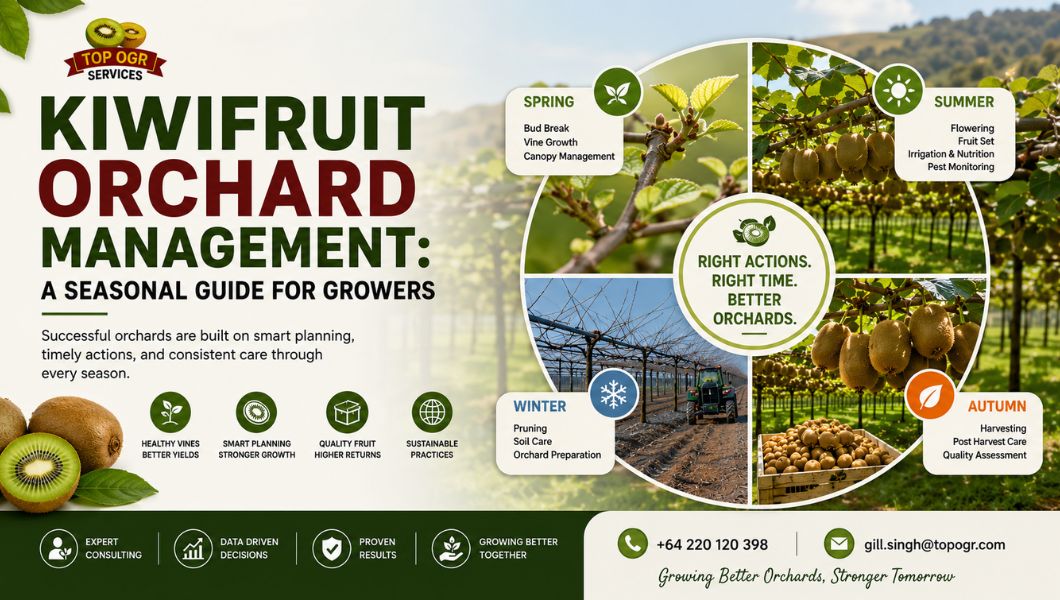
Kiwifruit Orchard Management: A Seasonal Guide for Growers
- August 22, 2026
The productive kiwifruit orchard relies on decisions made throughout the whole year. Pruning, canopy management, irrigation, nutrition, pollination, pest monitoring and harvest planning are all part of building a successful orchard.
Knowing when things should be done is particularly important for New Zealand kiwifruit growers as each phase of vine growth gives a different list of priorities.
As a whole the cycle of the growing year runs from the annual winter pruning and preparatory work, into spring growth and pollination and then summertime fruit development and finally autumn harvest.
Successful kiwi fruit orchard management means looking ahead and being proactive. The decisions you make now will have an impact on the strength and health of the vines in the coming seasons.
This guide covers the seasonal considerations every grower will need to think about and highlights why a scheduled approach to kiwifruit orchard management can make your life easier.
Why Seasonal Orchard Management Is Important
A kiwifruit vine cannot be treated the same all year round. As the vines grow and reach different stages, the priorities of your orchard will change, and you’ll need to adapt accordingly. You should also remember to manage based on individual blocks and consider what will work for your specific needs.
For instance, winter allows a time to focus on the vine structure, before spring initiates new growth and pollination needs. Summer will demand attention as growth ramps up, leading to harvest preparations for the autumn period.
With a clear seasonal strategy, kiwifruit growers can:
- Plan labor needs before the intense periods.
- Prepare your plants for future growth cycles.
- Monitor the condition of the fruit and vine.
- Use water and nutrients efficiently.
- Detect and treat potential problems promptly.
- Avoid last-minute panic at harvest time.
- Keep a consistent orchard structure.
The specific timings will differ for many growers as they are dependent on the variety, the local climate and how the orchard has been managed. A generalized seasonal calendar is therefore, the guide, and not a strict set of rules.
Wintertime: Preparing And Pruning the Vines
Winter runs in NZ from around July to August, the fruit have been harvested, the vines are starting to go dormant and a big dose of pruning is required. Pruning in winter encourages good structural development of the vine frame, preparing the orchard for the next growing cycle.
What will the vines need in winter?
Winter orchard work can include:
- Removing old or unsuitable fruiting canes
- Selecting productive canes for the following season
- Tying down suitable canes
- Maintaining an open canopy structure
- Checking orchard infrastructure
- Reviewing irrigation systems
- Planning labour and upcoming inputs
Pruning needs to be carried out carefully. Removing too much productive wood can reduce future potential, while leaving excessive growth can create a dense and difficult canopy. Good cane spacing also matters. An even structure helps create a more manageable canopy during the growing season and supports better access for orchard activities. Winter is also a useful time to review what happened during the previous season. Which areas produced well? Where did canopy growth become difficult to manage? Were there irrigation issues or recurring pest concerns?
The observations during this time can help plan next seasons management practices in the orchard.
Spring: Bud break, Flowering and Pollination As we enter the spring, the orchard starts to wake up. Typically between the months of August to November (depending on the hemisphere you are in), you will notice new shoots and developing flower buds as the weather becomes warmer, and vines begin their growth cycle again. This time of the season is vital as flowering and pollination impact the upcoming fruit harvest.
Key spring priorities
- Growers may need to monitor:
- Bud development
- Shoot growth
- Flowering
- Pollination activity
- Irrigation requirements
- Nutrient needs
- Pest and disease pressure
- Canopy development
One important aspect ispollination; the production of kiwifruit is entirely dependent on successful pollination, so during the flowering season, bees are critical. Meanwhile, the canopy of the kiwifruit vine should be controlled rather than encouraged.
A well-managed canopy helps maintain suitable light and airflow through the vines.
Spring is also a good time to identify weak areas early. A problem noticed during this stage may be much easier to manage than the same issue discovered close to harvest.
Summer: Canopy Management and Fruit Development
Summer, generally December through February, is when vine and fruit growth become especially active. The canopy can develop rapidly, so regular monitoring and management become important.
The goal is not simply to produce as much foliage as possible. Excessive growth can create shading and make orchard work more difficult.
Why does canopy management matter?
- A balanced canopy can help provide:
- Better light distribution
- Improved airflow
- Easier access for orchard work
- More effective spray coverage
- Suitable fruit development conditions
- Better preparation for the following season
NZKGI guidance notes that summer pruning helps manage excess vegetative growth and maintain suitable light levels around the fruiting canopy. However, removing too much canopy can also create problems, including increased exposure to sun damage.
Timing therefore matters.
Summer is also the period when fruit development needs close attention. Depending on the variety and orchard conditions, growers may assess fruit load, size and vine balance while continuing irrigation, nutrition and pest monitoring.
Irrigation and Nutrition Through the Growing Season
Water and nutrition should not be treated as separate from the rest of orchard management. Both need to support the vine without encouraging unnecessary growth or creating avoidable stress.
Irrigation requirements can change with weather, soil conditions, vine development and fruit growth. A well-managed system should provide water consistently while avoiding unnecessary wastage.
Nutrition also needs to be considered in relation to the orchard’s condition rather than applied through a one-size-fits-all approach.
Useful information can come from:
- Soil testing
- Leaf analysis
- Orchard observations
- Vine growth patterns
- Fruit development
- Previous season records
This information can help growers make more informed decisions about nutrient applications and irrigation scheduling.
Top OGR Services states that its orchard management approach includes soil and orchard assessment, nutrient planning and irrigation optimisation as part of its broader support for New Zealand growers.
Pest, Disease and Canopy Monitoring
Pest and disease management should be part of everyday orchard observation rather than something left until a visible problem becomes widespread.
Regular checks allow growers to notice changes in vine health, leaf condition, fruit development and canopy density.
What should growers look for?
- Routine observations may include:
- Unusual leaf changes
- Weak or damaged shoots
- Signs of pest activity
- Fruit damage
- Excessive moisture
- Dense or tangled growth
- Areas with poor airflow
- Changes in vine vigour
Canopy structure can influence several aspects of orchard performance. Open vines allow better light penetration and airflow, while also making orchard operations such as spray coverage more manageable.
However, pest and disease programmes should always follow current industry guidance and the requirements that apply to the particular orchard.
Autumn: Preparing for Kiwifruit Harvest
Autumn marks one of the busiest stages of the kiwifruit production cycle.
Harvest timing is not simply a matter of looking at the fruit and deciding that it appears ready. Fruit maturity needs to be assessed against appropriate harvest criteria before picking begins. Zespri’s harvesting guidance explains that harvest readiness is determined using defined maturity criteria, with timing varying according to variety, orchard conditions and management practices.
What happens before harvest?
Pre-harvest preparation can include:
Assessing fruit maturity.
Monitoring orchard conditions.
Planning harvest labour.
Preparing bins and equipment.
Organising access through the orchard.
Reviewing fruit handling procedures.
Coordinating transport and post-harvest arrangements.
Harvest itself needs careful handling.
Once the fruit has become ready it needs to be handled and transported without further unnecessary damage.
New Zealand’s harvest season can extend for many months as each variety of kiwifruit becomes ready to harvest at different stages.
Kiwifruit Harvest: timing and handling are vital
Harvest is the culmination of months in the orchard and months spent with meticulous attention in planning the orchard could still be jeopardized by poor planning and careless handling at harvest.
Kiwifruit are usually hand picked and at the harvest team are expected to work quickly and handle the fruit gently. Once picked fruit moves into the post harvest supply chain, grading and packing will then commence.
For many growers planning harvest needs to extend beyond acquiring the adequate staff to pick the crop.
The planning process may include considerations such as:
Harvest readiness
Climate conditions
Labour pool available
Orchard access
Picking techniques
Bin management
Logistics of transport
Coordination with downstream facility/facility
Careful planning will mean the difference between a smoothly organised harvest and one that creates delays and stress.
Post-Harvest: Get Ready for Next Year
Orchard management doesn’t end with the removal of all the fruit from vines. Immediately after harvest, many growers will look back at the season’s outcomes and start to consider next year’s production. It’s a prime opportunity to reflect on successes, setbacks and opportunities for improvement.
Questions growers may ponder include:
Were the orchard blocks able to meet potential?
Was canopy structure easily managed?
Did crop require the amount of water needed?
Did pest and disease have a consistent presence?
Was work availability causing any delays to the picking process?
Was the harvest process well organised?
Did any particular vines need greater attention next growing season?
This information is a good reference point for pruning, which generally starts over the winter.
The New Zealand kiwifruit growing year is cyclical. When the harvest is complete, vines naturally ‘shut down’, resulting in leaf-fall and dormancy – just as winter prunning takes place and preparing the ground for a whole new production season.
A simple check list of seasonal operations will give growers an overview of all activities in and around the orchard:
Season Main focus Key management areas Winter Structure;
Winter pruning,
cane selection and tying,
overall orchard preparation Spring Growth;
Bud break,
pollination,
irrigation,
nutrition,
pest observation Summer Structure;
Summer pruning,
maintaining plant balance,
growing crop,
water and nutrition Autumn Harvest;
Crop maturity,
labour planning,
harvesting and packing,
transport,
managing facility post-harvest Post-harvest;
Review and preparing for next season;
assessing plants,
recording and maintenance.
A general, overall list that can guide planting in spring but can be easily adapted based on individual orchard, crop, vine, climatic, and local needs.
Professional Orchard Management A multitude of decisions have to be considered when managing orchards, sometimes from a growers’ point of view that many growers are involved in with varying levels of involvement depending on their own situation.
Larger growers and those who rely more on their fruit businesses for overall income are generally prepared to have further assistance in the management of their horticultural assets through the services of specialised professional orchards management operations that assist with aspects such as pruning, canopy management, orchard assessments, irrigation strategy, nutrient management, pest and disease identification and monitoring, harvest preparation, and the staffing required for pruning and harvesting.
The benefits to the grower of having specialised orchard management service providers do not lie in just having additional people to perform the physically demanding tasks.
Professional orchard managers are key to assisting growers to see how individual activities relate to the overall production schedule.
Top OGR Services uses an individualised approach that “considers individual crop types, orchard characteristics and grower requirements, providing assistance for from orchard development through harvest,” to support growers’ orchards.
The most successful of the orchard management procedures currently in place rely on the principles of observation, timing and planning.
Rather than wait for issues to be unavoidable, growers that maintain consistent records on their orchard through observation and planning will achieve greater results.
Consider:
Harvest readiness
Weather conditions
Labour availability
Orchard access
Picking methods
Bin management
Transport coordination
Communication with post-harvest facilities
Good coordination can make the difference between a controlled harvest and a stressful one.
After Harvest: Start Planning the Next Season
Harvest does not mean orchard management stops.
Once fruit has been removed, growers can review the season and begin preparing for the next production cycle.
This creates an opportunity to assess what worked, what caused difficulties and where improvements could be made.
Useful post-harvest questions include:
Which blocks performed best?
Was the canopy easy to manage?
Were irrigation requirements met?
Were there recurring pest or disease concerns?
Did labour availability create delays?
Were harvest operations organised efficiently?
Which vines may require closer attention next season?
This information becomes particularly valuable when winter pruning begins.
The New Zealand kiwifruit growing cycle effectively connects one season to the next. Harvest is followed by leaf fall and dormancy, creating the conditions for winter pruning and the beginning of another production cycle.
A Simple Seasonal Kiwifruit Orchard Management Checklist
A seasonal checklist can help growers keep major tasks visible throughout the year.
SeasonMain focusKey management areas
WinterVine structureWinter pruning, cane selection, tying and orchard preparationSpringGrowth and floweringBudbreak, pollination, irrigation, nutrition and pest monitoringSummerCanopy and fruit developmentSummer pruning, canopy balance, fruit growth, water and nutritionAutumnHarvestFruit maturity, labour planning, picking, handling and transportPost-harvestReview and preparationOrchard assessment, records, maintenance and planning
This is a planning framework rather than a fixed prescription. Orchard conditions, variety, vine age, weather and local requirements can all influence the timing of individual tasks.
How Professional Orchard Management Can Help
Managing an orchard involves many decisions at once. For smaller operations, growers may handle much of the work themselves. Larger or busy orchards may benefit from additional specialist support.
Professional orchard management services can assist with planning and coordinating activities such as:
Pruning and canopy management
Orchard assessments
Irrigation planning
Nutrient management
Pest and disease monitoring
Harvest preparation
Labour coordination
Post-harvest planning
The value of professional support is not simply having another person available to complete physical work. Experienced orchard managers can help connect individual tasks to the wider production cycle.
Top OGR Services describes its approach as tailored to individual orchard conditions, crop varieties and grower goals, with support extending from orchard development through harvest.
Building a More Consistent Orchard Management Routine
The strongest orchard management systems are usually built around observation, planning and timing.
Rather than waiting until a task becomes urgent, growers can keep records throughout the year
Growers can use a season plan to ensure the important tasks of a vinegrowing year are kept in view.
Season Main focus Key management areas Winter Vine structure Winter pruning, cane selection, tying and orchard preparation Spring Growth and flowering Budbreak, pollination, irrigation, nutrition and pest monitoring Summer Canopy and fruit development Summer pruning, canopy balance, fruit growth, water and nutrition Autumn Harvest Fruit maturity, labour planning, picking, handling and transport Post-harvest Review and preparation Orchard assessment, records, maintenance and planning
This is a planning tool rather than an inflexible rigid structure, local environmental conditions, variety grown, vine age, time of season, and local labor factors will impact on the timely execution of specific management tasks.
How Professional Orchard Management Can Help Managing an orchard involves many decisions at once. For smaller operations, growers may handle much of the work themselves. Larger or busy orchards may benefit from additional specialist support. Professional orchard management services can assist with planning and coordinating activities such as: Pruning and canopy management Orchard assessments Irrigation planning Nutrient management Pest and disease monitoring Harvest preparation Labour coordination Post-harvest planning The value of professional support is not simply having another person available to complete physical work. Experienced orchard managers can help connect individual tasks to the wider production cycle. Top OGR Services describes its approach as tailored to individual orchard conditions, crop varieties and grower goals, with support extending from orchard development through harvest. Building a More Consistent Orchard Management Routine The strongest orchard management systems are usually built around observation, planning and timing. Rather than waiting until a task becomes urgent, growers can keep records throughout the year.
You can make valuable use of notes on pruning, irrigation, plant health, fruit development, labour demand and harvest yield. It would be worthwhile block-by-block, too. One block might have a particular soil, drainage, plant vigour or exposure relative to another; applying the same management to the whole area might miss what’s best for individual areas.
A seasonal view of orchard operations can help New Zealand kiwifruit growers with both daily activities and long-term production goals.
Final Thoughts Caring for kiwifruit plants year round is key. Winter pruning is the foundation for building the framework of the vines; spring involves managing new growth and flowering; summer brings an focus on the canopy and fruit; autumn is the harvest.
The operation doesn’t cease with harvesting the last fruit; review and planning to the next season will follow.
The best strategy?
Understanding vine requirements for each stage of growth and tailoring orchard management accordingly.
With thoughtful management and timely interventions, vines remain healthy and produce consistent fruit yields.
Frequently Asked Questions What is kiwifruit orchard management?
Kiwifruit orchard management involves the overall care of kiwifruit vines, soil, water, plant structure, fruit, and orchard operations, covering the entire production cycle of this fruit.
Among its key practices are pruning, irrigation, fertilization, pollination, pest management, and planning for harvesting.
Which season is most critical in kiwi fruit orchard management?
Each season is crucial in kiwifruit orchard management, as each affects what follows in the growing cycle.
Winter pruning sets the stage for the season ahead.
Spring blossoms and pollination are vital for fruit set. Summer canopy management and summer pest and disease management ensure strong fruit growth and development.
Autumn involves preparing for harvest and managing the last few stages of fruit maturity on the vines.
When do they harvest kiwifruit?
While timing can vary according to fruit varieties and climate, the New Zealand kiwifruit harvest generally takes place from late summer through the autumn and can extend into early winter.
Information from Zespri, a major New Zealand kiwifruit marketer, suggests the harvest period spans from late February to early July, depending on the fruit type.
Why is a kiwi fruit branch trimmed, removed, or shortened in a orchard?
Pruning manages the architecture of the plant, controlling the number and density of fruit-bearing branches.
Good pruning facilitates penetration of light and air through the vine, aids management during the season and encourages the growth and development of more fruitful wood at the proper locations.
Can an orchard management approach be adapted to an individual needs? Yes.
Orchard management is customizable to factors including fruit varieties, age of the plants, features of blocks, the size of the orchard, and objectives of the orchard owners.
A personalized approach typically works better than a standard programme applied in identical fashion to all orchards.
Recent Posts

October 7, 2026

October 4, 2026
October 4, 2026
September 30, 2026
September 29, 2026
September 25, 2026