
How Technology Is Changing Kiwifruit Orchard Management in New Zealand
- August 13, 2026
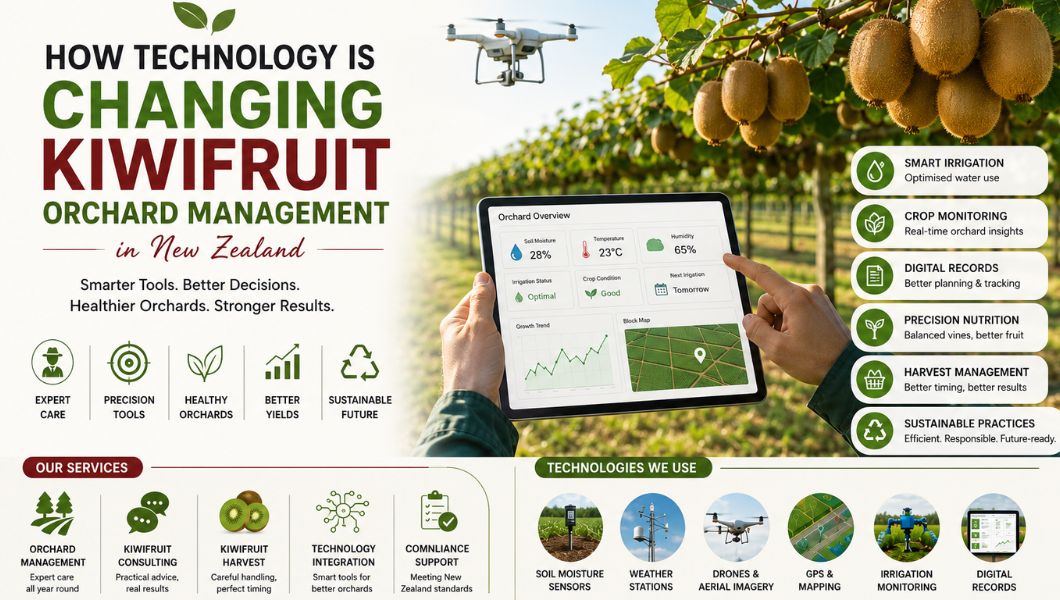
Managing a kiwifruit orchard requires foresight, knowledge and observation. Technology is revolutionising the management of many tasks within an orchard. Monitoring soil moisture.
Adjusting irrigation.
Monitoring crop condition. Enhanced crop planning. In Kiwifruit Orchard Management, technology gives growers more information. Technology gives growers more decisions that can be based on fact and real data.
It supplements knowledge.
How Technology Is Changing Orchard Management
Modern orchard technology is being used to monitor different parts of the growing operation.
Information can be collected from:
- Soil moisture sensors
- Weather monitoring systems
- GPS tools
- Drones
- Digital orchard records
- Crop monitoring equipment
- Irrigation systems
This information can be used to understand what is happening across different orchard blocks.
Not every area of an orchard performs in the same way.
Soil conditions can vary.
Water requirements can vary.
Plant growth can also vary.
Technology can help these differences be identified earlier.
Smarter Irrigation and Water Management
Water management is a major part of orchard management.
Traditional irrigation schedules are often based on weather and experience.
Technology can provide more information.
Soil moisture can be monitored.
Weather conditions can be tracked.
Irrigation requirements can be reviewed more closely.
This can help identify areas that may be too dry or too wet.
Irrigation can then be adjusted where needed.
Top OGR Services includes smart water management and irrigation optimisation within its orchard management approach. (topogr.com)
The aim is simple.
The right amount of water should be supplied at the right time.
Healthy vines need suitable nutrition.
More Accurate Nutrient Management
Nutrient requirements can change during the growing season.
They can also vary between orchard areas.
Soil information and crop observations can be used to support better nutrient decisions.
This can help reduce unnecessary applications.
It can also help problem areas be identified.
A blanket approach is not always suitable for every orchard block.
More detailed information can allow decisions to be made according to actual orchard conditions.
Earlier Detection of Orchard Problems
Pests and diseases can affect vine health and fruit production.
Water stress can also cause problems.
Nutrient issues may not always be visible immediately.
Regular monitoring can help changes be noticed earlier.
Technology can support this monitoring.
Images, sensors, and digital records can be used to identify unusual conditions.
A physical inspection is still important.
Technology should support experienced orchard staff.
It should not replace them.
Biosecurity is also an important part of kiwifruit production in New Zealand.
The movement of people, equipment, and plant material can create biosecurity risks.(mpi.govt.nz)
Good orchard hygiene and monitoring remain essential.
Drones and Digital Mapping
Drones are being used in agriculture for monitoring and mapping.
They can provide an aerial view of orchard blocks.
Some areas can be difficult to assess from ground level.
Aerial images can help highlight areas that need closer inspection.
GPS and mapping tools can also be used.
They can support:
- Orchard block mapping
- Crop monitoring
- Canopy assessment
- Irrigation planning
- Orchard records
- Operational planning
MPI identifies drones, GPS, LiDAR, and geospatial technology as tools that can support agricultural monitoring and precision management. (mpi.govt.nz)
The data still needs to be understood correctly.
A useful system is one that leads to practical action.
Technology and Kiwi Fruit Harvesting
Harvesting is a critical stage.
Timing matters.
Fruit maturity needs to be assessed.
Labour needs to be organised.
Fruit needs to be handled carefully.
Technology can support each part of this process.
Orchard records can be reviewed.
Maturity information can be monitored.
Harvest teams can be scheduled.
Harvest areas can be planned.
Top OGR Services provides harvest support that includes orchard assessment, harvest timing, fruit handling, and delivery to post-harvest facilities. (topogr.com)
Technology is also being explored for harvesting automation.
MPI has reported research into robotic harvesting and crop detection technology. (mpi.govt.nz)
Robotics may become more common in future.
Skilled workers will still play an important role.
Digital Records Make Management Easier
An orchard produces a large amount of information.
Irrigation records are created.
Nutrient applications are recorded.
Pest observations are made.
Harvest information is collected.
Labour activities are tracked.
Digital systems can keep this information organised.
Records from previous seasons can also be reviewed.
This can help patterns be identified.
For example, one orchard block may regularly perform below expectations.
Past records can then be checked.
Possible causes may include:
- Irrigation
- Soil conditions
- Nutrition
- Canopy management
- Pest pressure
- Disease
- Crop load
Better records can make these investigations easier.
Technology Can Support Sustainable Orchard Management
Sustainability is becoming an important part of modern orchard management.
Better monitoring can support more efficient resource use.
Water can be monitored more closely.
Nutrient applications can be better targeted.
Orchard problems can be identified earlier.
Soil conditions can also be monitored.
MPI-backed research has examined soil organic carbon in kiwifruit orchards and its relationship with soil water, nutrients, microbial activity, and drainage. (mpi.govt.nz)
Technology alone does not create a sustainable orchard.
Good management is still required.
The Role of Kiwifruit Consulting
Technology provides information.
People still need to interpret it.
A sensor may show low soil moisture.
An orchard manager needs to decide why it happened.
The irrigation system may need to be checked.
The soil may need to be assessed.
The vine condition may need to be reviewed.
This is where Kiwifruit consulting can be useful.
Experienced professionals can combine technology with practical orchard knowledge.
The information can then be turned into an appropriate management decision.
Why a Kiwifruit Management Company Still Matters
Technology is useful.
It is not a replacement for experienced orchard management.
Kiwifruit production still involves:
- Vine management
- Pruning
- Canopy management
- Irrigation
- Nutrition
- Pest management
- Disease monitoring
- Pollination
- Harvest planning
- Labour coordination
- Compliance
A professional Kiwifruit management company can bring these tasks together.
Technology can be added to the process.
This creates a more complete management system.
Top OGR Services describes its orchard management approach as covering site assessment, orchard health, nutrient management, pest management, canopy management, vine training, technology integration, sustainability, harvest support, and compliance. (topogr.com)
What Should Growers Look for in Orchard Technology?
Not every technology will suit every orchard.
Before investing in a new system, growers should ask:
What problem will it solve?
The technology should have a clear purpose.
Can the information be used?
Data should lead to a practical decision.
Is it suitable for the orchard?
Soil, terrain, vine variety, and infrastructure should be considered.
Can the team use it?
A complicated system may not be useful if it cannot be managed properly.
Can it work with existing systems?
New technology should fit into the current orchard management process.
Who will interpret the data?
Information is only useful when it is understood.
What Does the Future Look Like?
Technology is expected to play a larger role in orchard management.
More systems are being developed for:
- Automated monitoring
- Machine vision
- Robotics
- Crop tracking
- Remote sensing
- Digital orchard records
- Predictive management
New Zealand’s kiwifruit sector is already supporting innovation in on-orchard technology and decision-support tools. (mpi.govt.nz)
The focus is not technology for its own sake.
The focus is better orchard decisions.
For New Zealand Kiwifruit Growers, this can mean better monitoring and more informed planning.
Professional Orchard Management in New Zealand
Technology has changed the tools available to growers.
The basics of good orchard management remain important.
Healthy vines still need to be maintained.
Irrigation still needs to be managed.
Nutrition still needs to be monitored.
Pests and diseases still need attention.
Harvest timing still matters.
A professional Orchard Management Company can help bring these areas together.
Technology can then be used where it provides genuine value.
Top OGR Services provides orchard management and related support for kiwifruit growers.
Its approach combines practical horticultural knowledge with modern orchard technology.
For growers looking to improve their orchard operations, professional Orchard Management Services can provide useful support.
Explore Top OGR Services to learn more about its orchard management approach.
FAQs
How is technology improving Kiwifruit Orchard Management?
Technology helps monitor soil moisture, weather, crops, irrigation, and orchard records. This supports better management decisions
Can technology help with kiwi fruit harvesting?
Yes. Digital records, crop monitoring, and maturity tracking can support better harvest planning and labour management.
Can technology reduce water use?
Yes. Soil moisture and weather data can help irrigation be adjusted to orchard needs.
Why are digital orchard records useful?
They keep irrigation, nutrition, pest, labour, and harvest information organised. This helps with future planning.
Is Kiwifruit consulting still needed?
Yes. Technology provides data, while consultants help interpret it and apply it to orchard conditions.
What technology is used in modern orchards?
Common tools include soil sensors, weather stations, GPS, drones, digital records, and irrigation monitoring systems.
Why use a Kiwifruit management company?
A professional team can manage irrigation, nutrition, pest control, harvesting, compliance, and other orchard activities.
Recent Posts

October 7, 2026

October 4, 2026
October 4, 2026
September 30, 2026
September 29, 2026
September 25, 2026